What Temperature Should You Set Your AC in Summer?
The standard advice is 78°F when you're home and a few degrees higher when you're out. In a North Texas summer that's sound, with…
The standard advice is 78°F when you're home and a few degrees higher when you're out. In a North Texas summer that's sound, with one caveat worth knowing: on a 100°F afternoon, most residential systems physically cannot reach much below 78 anyway.
The 20-degree rule
A correctly working residential AC can pull indoor temperature roughly 20 degrees below outdoor. On a 100°F day that's about 80°F indoors, at full tilt.
So if it's 102 outside and your house is sitting at 80, your system probably isn't broken — it's at its physical limit. That's worth knowing before you pay for a diagnostic.
If the gap is much smaller than 20 degrees, that is worth investigating. It usually points to low refrigerant, a dirty coil, or duct losses.
Setting it lower does not cool faster
An AC doesn't have a throttle. Setting the thermostat to 65 instead of 75 doesn't make it work harder — it just makes it run longer, past the point you wanted, using more electricity to overshoot.
What actually helps
- Close blinds on the sun side. Free, and surprisingly effective in a Texas afternoon.
- Ceiling fans in occupied rooms. They cool people, not rooms — so turn them off when you leave.
- Raise it 4–7 degrees when out, rather than switching off entirely. A system restarting a 15-degree climb in August works harder than one holding a smaller gap.
- Keep interior doors open so the house equalises.
If you can't hold temperature at all
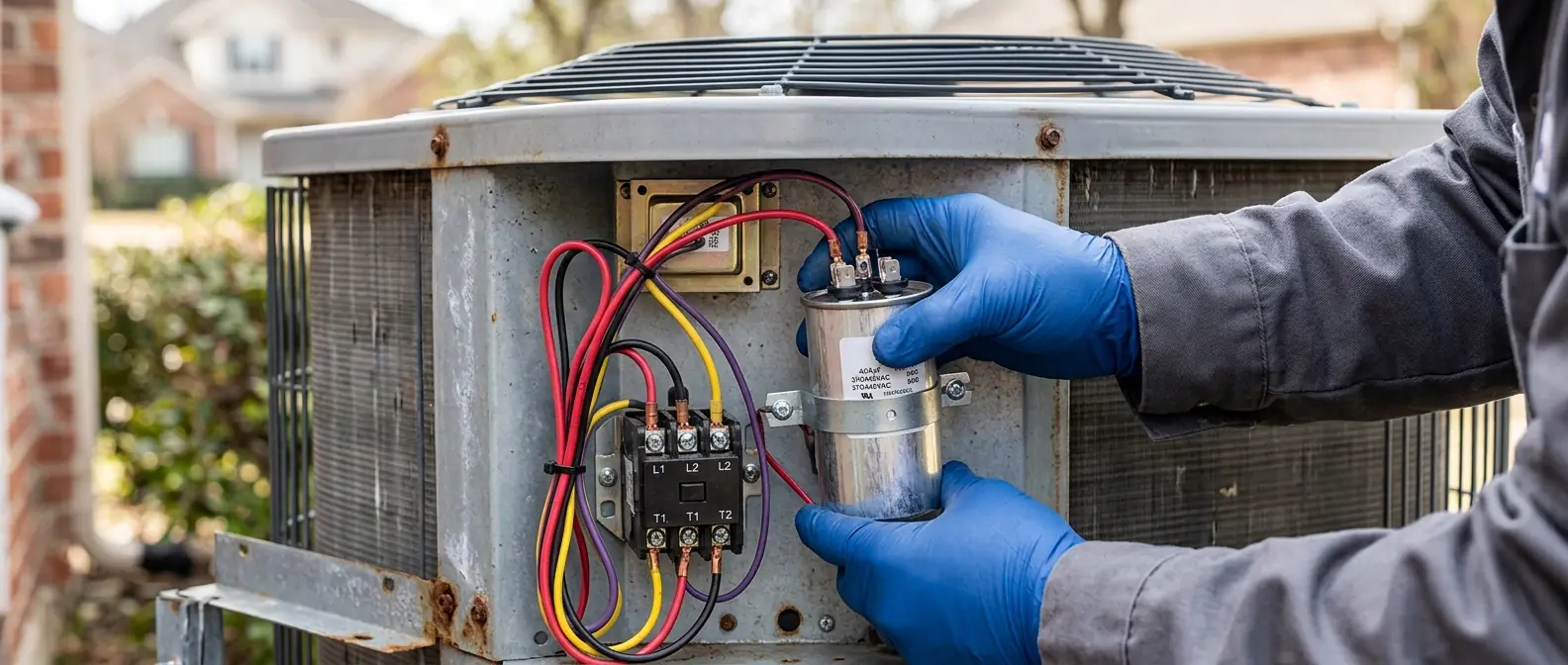
If the house won't hold 78 on a normal day, or one room never gets there, that's a fault worth diagnosing — most often low refrigerant, a failing capacitor, or duct problems.
Need this looked at in Frisco or nearby? Our diagnostic is $99, credited to the repair, and you get a fixed price before any work starts. Get it diagnosed →
Get a real price for your repair
$99 diagnostic, credited when you go ahead.